Statistical Process Control (SPC) has been part of manufacturing quality systems for decades. Yet, despite widespread adoption, OEMs and suppliers continue to struggle with the same fundamental issues—often revealed during audits, supplier reviews, or escalation situations.
The problem is rarely a lack of intent or knowledge. In most cases, it’s how SPC is defined, implemented, and expected across the supply chain.
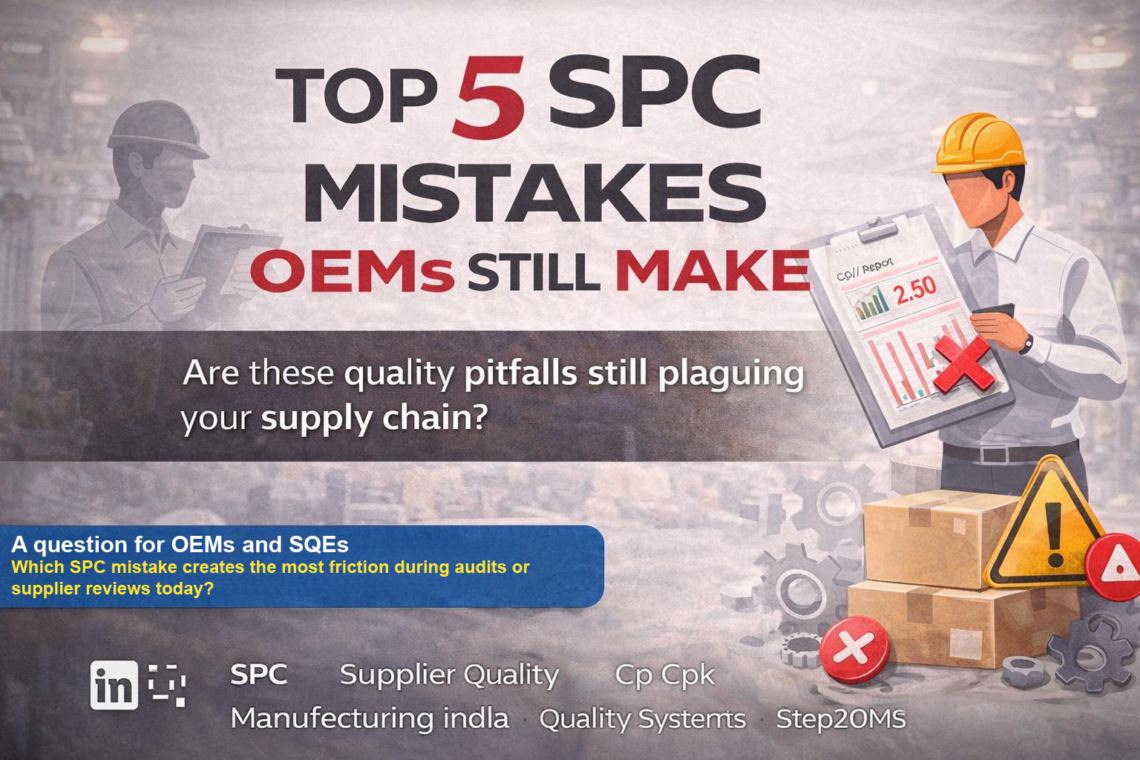
Below are the top five SPC mistakes OEMs still make, even today.
1️⃣ Treating SPC as a compliance requirement
One of the most common mistakes is viewing SPC primarily as an audit deliverable.
In many supplier environments, SPC is something that:
- Is prepared before an audit
- Is shown to auditors or OEM representatives
- Is not actively used by operators or process owners
When SPC is reduced to a compliance activity, it loses its core purpose: process control. Control charts should guide daily decisions, detect instability early, and trigger corrective action—not simply exist as evidence in a file.
OEMs that implicitly encourage “audit-only SPC” often find themselves reviewing impressive reports that don’t reflect actual shop-floor behavior.
2️⃣ Focusing only on Cp & Cpk values
Cp and Cpk are important indicators—but they are outcomes, not control mechanisms.
A frequent issue seen during OEM audits is:
- Acceptable Cp/Cpk values
- Little or no evidence of process stability
- Missing or incomplete control charts
Without X-Bar, R-Bar, or appropriate control charts, Cp/Cpk values can be misleading. A capable number calculated on unstable or mixed data sets does not represent a controlled process.
OEM SPC expectations should emphasize:
- Process stability before capability
- Trend behavior, not just final indices
- Evidence of action taken when variation occurs
3️⃣ Accepting Excel-based SPC as a standard
Excel continues to be widely used for SPC because it is accessible and familiar. However, Excel-based SPC introduces serious limitations when used as a long-term standard:
- Manual data handling increases risk of errors
- Limited traceability of who entered or modified data
- Inconsistent formats across suppliers and plants
- No built-in control logic or audit trail
For OEMs managing multi-plant or multi-supplier ecosystems, Excel makes it nearly impossible to ensure consistency, repeatability, and trust in SPC data.
As supply chains scale, SPC systems must scale as well—Excel simply does not.
4️⃣ No linkage between SPC data and part location
Another critical gap is the absence of visual and contextual linkage between SPC results and the actual part.
In many SPC reports:
- Variation is identified
- Out-of-control points are highlighted
- But the where and why remain unclear
When SPC data is not linked to part images, CAD features, or process stages, root cause analysis becomes slower and more subjective.
OEMs increasingly expect SPC not just to flag variation, but to support faster diagnosis and corrective action. This requires clearer traceability between measurement data, part features, and process steps.
5️⃣ Inconsistent SPC expectations across suppliers
Perhaps the most underestimated issue is inconsistency.
OEMs often receive SPC reports that differ widely in:
- Format
- Subgroup definitions
- Sampling logic
- Control chart selection
This makes meaningful comparison across suppliers extremely difficult. It also leads to repeated clarification cycles during audits and reviews.
SPC becomes far more effective when OEMs define and enforce one common SPC language—so every supplier understands exactly what is expected and how performance will be evaluated.
Moving toward effective SPC
SPC works best when OEMs and suppliers align on:
- Control over compliance
- Stability over isolated indices
- Traceability over manual reporting
- Consistency across the supply chain
Structured SPC platforms like Step2QMS help enable this alignment by standardizing SPC logic, reporting formats, and traceability—allowing SPC to function as a daily quality control system, not just an audit artifact.
👉 From an OEM or SQE perspective:
Which SPC mistake causes the most friction during audits or supplier reviews today?
Your answer often reveals where SPC systems—not people—need improvement.